2026 WAEC Geography Answers
- 01-10: BCADDBDCAC
- 11-20: CDDABDCBCB
- 21-30: DBBBDABDCB
- 31-40: ADDBADCBAB
- 41-50: DCBCDCBDCB COMPLETED!!!
WAEC Geography Essay
Number 1
1a)
favourable balance of trade (also called a trade surplus) occurs when the total value of a country’s visible exports exceeds the total value of its visible imports over a given period, usually one year. This means the country earns more money from selling goods abroad than it spends on buying goods from other nations.WAEC Exam Updates
(1b)
(i)Production of Similar Goods: Most countries primary produce agricultural raw materials and minerals, leaving little basis for exchange.
(ii)Poor Transportation Networks: Inadequate cross-border roads, railways, and maritime links limit physical trade.
(iii)Trade Barriers: High tariffs, import quotas, and complex customs documentation discourage trading activities.
(iv)Currency Differences: The lack of a unified regional currency creates exchange rate risks and conversion difficulties.
(v)Political Instability: Civil unrest, border closures, and frequent changes in government disrupt long-term trade agreements.
1c)
(i)Increased Foreign Exchange Reserves: Accumulating stronger foreign currency reserves improves the nation’s financial stability.
(ii)Economic Growth: High export demand boosts domestic production, industrial expansion, and overall Gross Domestic Product (GDP).
(iii)Job Creation: Expanding export-oriented industries generates employment opportunities for local workers.
(iv)Currency Appreciation: Stronger export performance increases international demand for the local currency, boosting its value
Number 2
(2a)
(i)Employment Opportunities: Rural inhabitants look to cities for non-agricultural industrial, commercial, and administrative jobs.
(ii)Higher Education: Rural youths travel to urban centers to access universities, polytechnics, and specialized colleges.
(iii)Advanced Healthcare: Rural populations depend on urban teaching hospitals and specialized medical clinics for complex treatments.
(iv)Market for Farm Produce: Urban centers serve as the primary large-scale consumers for food and raw materials grown in rural areas.
(v)Manufactured Goods: Rural areas rely on cities to supply agricultural inputs (fertilizers, machinery) and consumer goods (electronics, processed clothing).Educational Consultation Services
(2b)
(i)Primary Economic Activities: The vast majority of the population is engaged in farming, fishing, lumbering, or cottage industries.
(ii)Low Population Density: Buildings are usually dispersed, linear, or nuclear with relatively few inhabitants per square kilometer.
(iii)Inadequate Infrastructure: There is a widespread lack of tarred roads, stable electricity, piped water, and modern sewage systems.
(iv)Traditional Building Materials: Homes are frequently constructed using local resources such as mud bricks, thatch, or corrugated iron sheets.
(v)Strong Social Cohesion: Communities are close-knit, with inhabitants sharing similar cultural values and knowing each other personally.
Number 3
(3a)
Forced migration is the involuntary movement of people away from their home region or country due to external factors that threaten their lives, freedom, or livelihood, such as war, political persecution, natural disasters, or environmental degradation.
(3b)
(i)Cultural and Language Barriers: Difficulty communicating fluently leads to social isolation and integration challenges.
(ii)Discrimination and Racism: Xenophobia and unfair treatment can limit access to housing, public services, and fair legal treatment.
(iii)Underemployment: Migrants often struggle to get their home-country educational credentials recognized, forcing them into low-wage, unskilled manual labor.
(iv)Strict Immigration Laws: Navigating complex legal frameworks can result in deportation threats, lack of legal residency, or restricted freedom of movement.
(3c)
(i)Labor Supply: Migrants provide essential manpower for agricultural plantations, construction projects, and local mining sectors.
(ii)Skill and Knowledge Transfer: Influxes of skilled laborers or artisans inject new technical competencies into the host economy.
(iii)Cultural Enrichment: The blending of diverse traditions, music, languages, and food systems creates a vibrant cultural environment.
(iv)Market Expansion: A growing population increases local consumer demand for food, housing, clothing, and transportation services.
(v)Rapid Urbanization: Migrant populations accelerate the physical growth and infrastructural development of receiving towns and cities.
Number 4
(4a)
Coming
(4b)
(i)Manual Labor: They rely heavily on hand tools and physical human effort rather than heavy automated machinery.
(ii)Family-Based Ownership: Skills and businesses are typically passed down through generations within families or small communities.
(iii)Local Raw Materials: They rely almost entirely on locally sourced materials, such as clay for pottery, wood for carving, and hides for leatherwork.
(iv)Small Capital Requirement: Setting up requires very little financial investment or overhead compared to modern
(4c)
(i)Job Creation: They provide employment opportunities for youths, women, and artisans in rural and urban areas.
(ii)Income Generation: Selling crafts serves as a steady source of income for local craftsmen and raises the standard of living.
(iii)Tourism Boost: Unique cultural crafts attract foreign and domestic tourists, bringing money directly into local economies.
(iv)Foreign Exchange Earnings: Exported traditional items like leather goods and woven fabrics generate foreign currency for the nation.
Number 5
(5a)
Plantation agriculture is a form of commercial farming where a single crop is grown on a large scale. It involves large estates, high capital investment, modern machinery, and hired labor. The crops are primarily grown for sale and export rather than local consumption.
(5b)
(i)Monoculture: Growing only one specific crop on a massive scale.
(ii)Large Estates: Farming takes place on vast tracts of land.
(iii)High Capital: Requires massive financial investment for operations and processing.
(iv)Hired Labor: Relies heavily on a large, paid workforce.
(v)Processing Facilities: Processing factories are usually built on-site.
(5c)
(i)Land Tenure: High difficulty in acquiring large, continuous land tracts.
(ii)Inadequate Capital: Limited access to loans for long-term investments.
(iii)Pests and Diseases: High risk of rapid crop damage due to monoculture.
(iv)Poor Infrastructure: Lack of good roads to transport harvested goods.
Number 6
(6a)
Coming
(6b)
(i)Overcrowding: Extreme pressure on housing leading to slums.
(ii)Unemployment: Job shortages due to a massive influx of laborers.
(iii)Traffic Congestion: Severe gridlock on poorly planned city roads.
(iv)Inadequate Infrastructure: Overstretched water, electricity, and health services.
(v)Increased Crime: Rising rates of theft, cultism, and social vices.
(6c)
(i)Rural-Urban Migration: Mass exodus of youths seeking better opportunities.
(ii)Lack of Amenities: Total absence of modern infrastructure and electricity.
(iii)Poor Job Prospects: Limited economic options outside of subsistence farming.
WAEC Practical and Physical Geography 2026
(1a)
IMAGE
CHECK THE MAP (It’s ticked there
(1b)
Distance from A to B = 16cm
Scale of the map = 1:50,000
If 1cm represents 50,000cm
..:. 16 cm = 16 x 50,000 = 800,000cm
1km = 100,000cm
800,000cm to km = 800,000/100,000
= 8km
Distance = 8km
(1c)
(i)Farming/Agriculture: Evidenced by plantations, cultivated fields, or scattered cultivation symbols.
(ii)Lumbering/Forestry: Evidenced by forest reserves, thick forest symbols, or sawmills.
(iii)Trading/Commerce: Evidenced by markets, shops, or dense road networks connecting settlements.
(iv)Transportation: Evidenced by roads, railway lines, footpaths, or bridges.
(1d)
(i)Settlements are typically built on gentle slopes or flat plains to avoid steep scarp slopes or flooded areas.
(ii)Roads and railways usually follow flat valleys or pass through gaps in hills to avoid steep gradients.
(iii)Human farming and plantations are established in areas clear of dense, protected forest reserves or rocky terrains.
Number 3
(3a)
A metamorphic rock is a rock that has been changed from its original form by intense heat, pressure, or chemical action within the Earth’s crust without melting completely.
(3b)
(i) Marble
(ii) Slate
(3c)
(i) Sedimentary rocks are formed by deposition, compaction, and cementation of sediments, while metamorphic rocks are formed when existing rocks are altered by heat and pressure.
(ii) Sedimentary rocks usually contain fossils, while metamorphic rocks rarely contain fossils because the fossils are destroyed during metamorphism.
(iii) Sedimentary rocks have distinct layers or strata, while metamorphic rocks have foliated bands or crystalline structures.
(iv) Sedimentary rocks are generally softer, while metamorphic rocks are generally harder.
(v) Sedimentary rocks are formed at or near the Earth’s surface, while metamorphic rocks are formed deep within the Earth’s crust.
4a)
Weathering is the mechanical breaking down or chemical alteration of rocks and minerals at or near the Earth’s surface by natural agents like water, wind, temperature changes, and biological organisms.
(4b)
(i)Soil formation: Breaks down solid rocks into fertile particles vital for agricultural farming.
(ii)Resource creation: Produces valuable economic mineral deposits like bauxite (aluminum ore) and clay.
(iii)Landscape carving: Shapes beautiful natural tourist landforms like caves, arches, and scenic valleys.
(4c)
(i)Climate: High temperatures and heavy rainfall accelerate chemical weathering processes.
(ii)Rock type: Mineral composition and structural cracks determine how easily a rock degrades.
(iii)Topography: Steep slopes expose rocks faster due to gravity removing protective surface debris.
(5a)
The biosphere is the global ecological system integrating all living beings and their relationships; it is the narrow zone of the Earth’s surface, waters, and atmosphere where life exists.
(5b)
(i)Food supply: Yields essential plant and animal products for human nutrition.
(ii)Climate regulation: Absorbs carbon dioxide and releases oxygen through massive forest photosynthesis.
(iii)Waste recycling: Decomposes organic matter to return vital nutrients back into the soil.
(iv)Raw materials: Supplies essential resources like timber, medicine, fiber, and fuel.
(5c)
(i)Contains all living organisms found on Earth.
(ii)Intersects directly with the atmosphere, lithosphere, and hydrosphere.
(iii)Depends entirely on solar energy to fuel its living systems.
(iv)Maintains a dynamic equilibrium through continuous nutrient cycling.
(v)Features highly diverse ecosystems adapted to varying global climates.
Number 6
6a)
An alluvial fan is a triangle-shaped deposit of gravel, sand, and smaller sediment formed where a fast-flowing river or stream leaves an upland steep valley and suddenly spreads out onto a flat plain.
(6b)
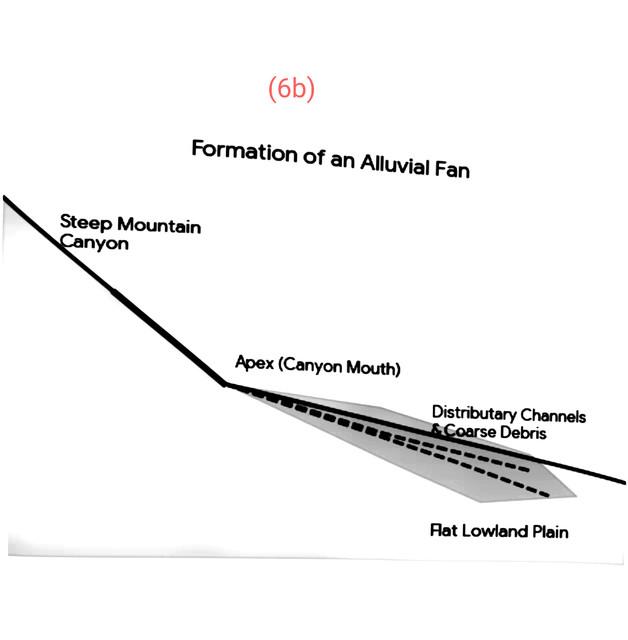
Mode of Formation
(i)Velocity drop: A river rushes down a steep, narrow mountain channel carrying large loads of sediment.
(ii)Sudden expansion: When the river hits the flat lowland plain, its lateral confinement disappears, and its speed drops instantly.
(iii)Deposition: Lacking the energy to carry its load, the river dumps its heaviest sediment at the mountain mouth, and finer materials settle further out in a fan shape.
Characteristics-
(i)Shape: Distinctly semi-circular or fan-shaped layout widening downward.
(ii)Sorting: Poorly sorted material with large rocks near the mountain mouth and finer sand at the outer edges.
(iii)Channels: Braided network of shifting distributary channels spreading out across the deposit.
Number 7
(7a)
(i)Distance from the sea (Continentality)
(ii)Prevailing wind direction
(iii)Presence of mountain barriers (Relief)
(iv)Ocean currents (Warm vs. cold currents)
Description-
(i)Angle of solar rays: At low latitudes (near the Equator), sun rays hit the Earth vertically at a direct angle, concentrating heat over a small surface area.
(ii)Atmospheric thickness: Rays hitting high latitudes travel through a thicker layer of atmosphere, scattering and losing heat before reaching the surface.
(iii)Surface spreading: At high latitudes (near the poles), the same amount of solar energy strikes at a slanted angle, spreading out over a much wider area and resulting in colder temperatures.
8a)
Water resources are natural sources of water on Earth that are potentially useful or directly beneficial to humans for survival, domestic chores, agricultural farming, or industrial processes.
(8b)
(i)Destruction of aquatic life: Toxic chemicals deplete dissolved oxygen levels, causing fish kills.
(ii)Spread of waterborne diseases: Contaminated water spreads illnesses like cholera, typhoid, and dysentery.
(iii)Disruption of food chains: Heavy metals build up in fish tissue, poisoning animals and humans higher up the food chain.

2026 WAEC Physics Practical Answers
2026 Free WAEC C.R.S Answers
WAEC Free Civic Education Answers 2926
About Author
