WAEC Free Civic Education Answers 2926
*WAEC CIVIC EDUCATION*
*NUMBER ONE*
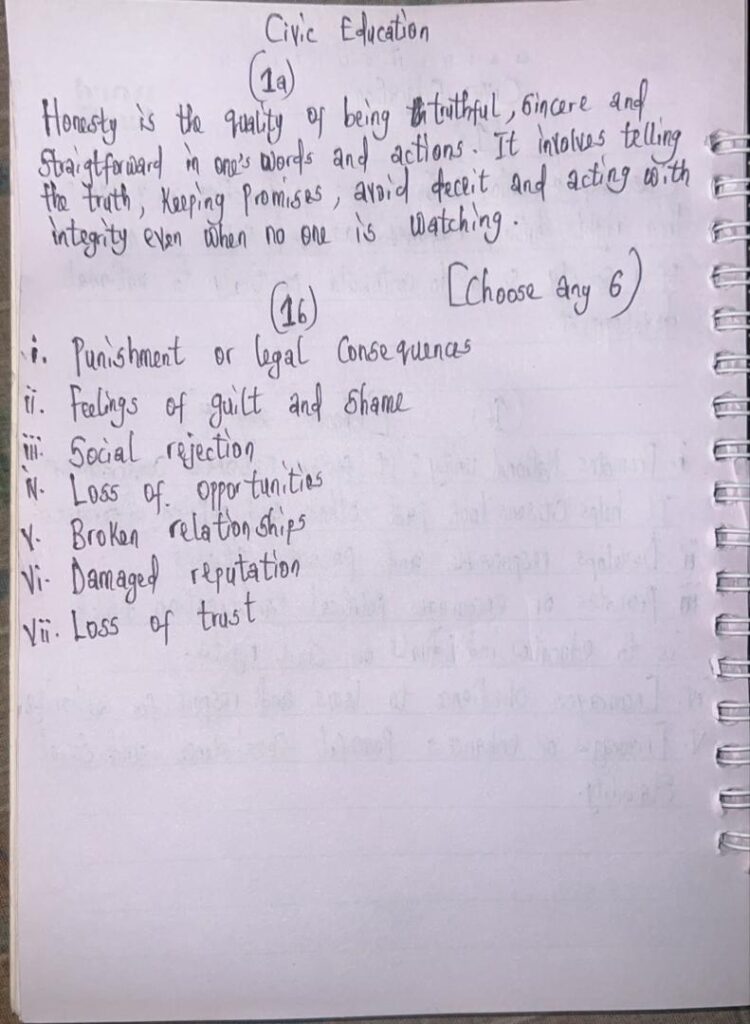
(1a)
Honesty is the quality of being truthful, sincere, and trustworthy in one’s words, actions, and dealings with others. It involves telling the truth, keeping promises, avoiding deceit, and acting with integrity at all times.
(1b)
(PICK SIX ONLY)
(i) Loss of Trust: When a person is dishonest, people gradually lose confidence in him or her. Once trust is broken, it becomes very difficult to regain it, and others may become reluctant to depend on the individual.
(ii) Damage to Reputation: Dishonesty can tarnish a person’s good name and image in society. Friends, family members, colleagues, and community members may develop a negative opinion of the individual.
(iii) Broken Relationships: Dishonest behaviour often creates conflicts and misunderstandings among friends, family members, and associates. This may lead to separation, resentment, and loss of valuable relationships.
(iv) Loss of Opportunities: Employers, teachers, and business partners prefer trustworthy individuals. A dishonest person may lose educational, employment, leadership, or business opportunities because of a lack of credibility.
(v) Legal Consequences: Certain dishonest acts such as fraud, forgery, theft, and false testimony may result in arrest, prosecution, fines, or imprisonment under the law.
(vi) Feelings of Guilt and Shame: Dishonesty often causes inner discomfort and emotional distress. The individual may experience guilt, regret, anxiety, and shame for engaging in wrongful actions.
(vii) Poor Moral Character: Repeated dishonest behaviour weakens a person’s moral values and integrity. Over time, the individual may find it easier to engage in more serious unethical activities.
(viii) Loss of Self-Respect: A dishonest person may begin to feel disappointed in himself or herself. This can reduce self-esteem and make the individual feel unworthy of respect and admiration.
(ix) Lack of Peace of Mind: Maintaining lies and deceptive actions often creates fear of being exposed. This constant worry can result in stress, tension, and emotional instability.
(x) Reduced Social Acceptance: Society generally values honesty and integrity. Individuals known for dishonesty may be avoided, rejected, or excluded from important social activities and positions of responsibility.
*WAEC CIVIC EDUCATION*
*NUMBER TWO*
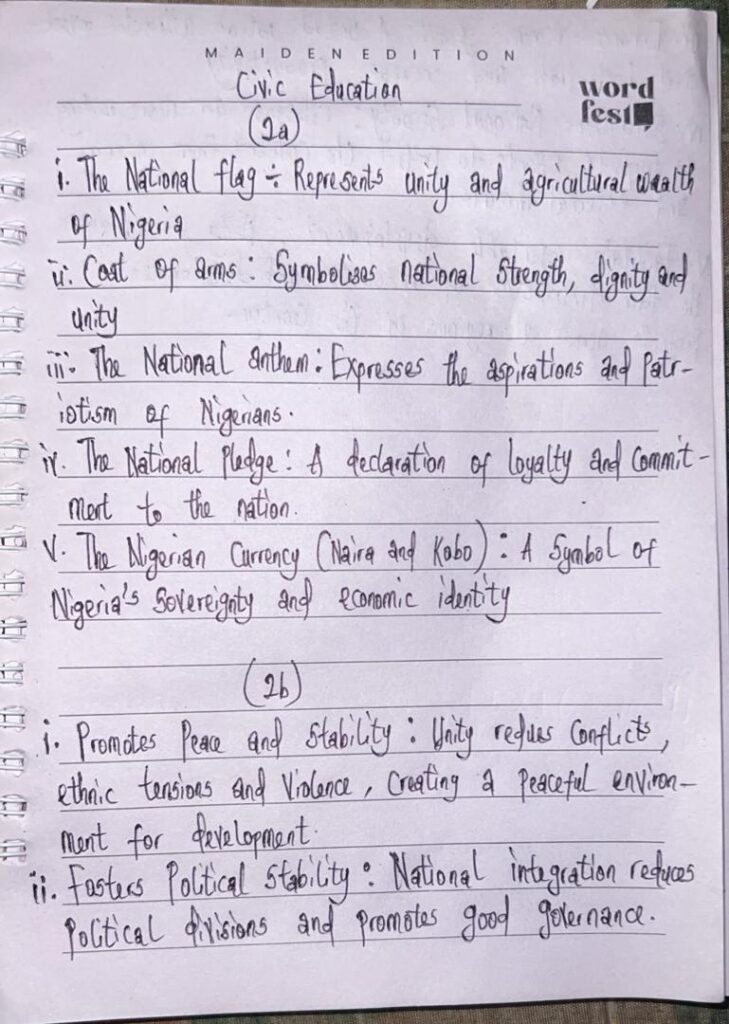
(2a)
(PICK FIVE ONLY)
(i) National Flag
(ii) National Anthem
(iii) National Pledge
(iv) Coat of Arms
(v) National Currency
(vi) National Constitution
(vii) National Identity Card
(viii) The President’s Seal
(2b)
(PICK FIVE ONLY)
(i) Promotes Peace and Stability: Unity and integration help to reduce ethnic, religious, and regional conflicts, thereby creating a peaceful environment necessary for growth and development.
(ii) Encourages National Loyalty: When citizens are united, they develop a stronger sense of belonging and commitment to the nation, which enhances patriotism and national consciousness.
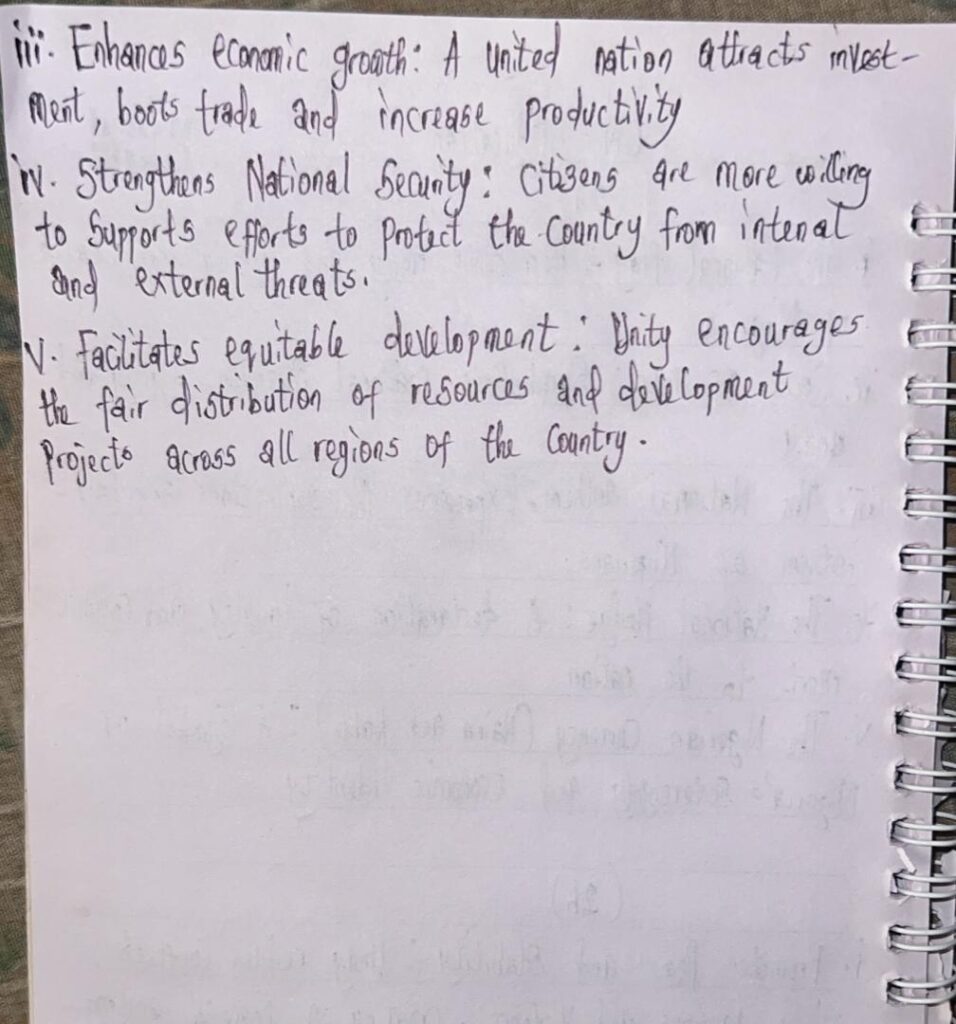
(iii) Facilitates Economic Growth: A united society attracts local and foreign investors because peace and cooperation create a favourable environment for business activities and economic expansion.
(iv) Enhances Political Stability: Unity among citizens promotes cooperation with government policies and reduces political tension, thereby ensuring a stable political system.
(v) Promotes Effective Utilisation of Resources: National integration encourages people from different parts of the country to work together in the effective management and use of available human and natural resources.
(vi) Encourages Social Development: Unity fosters cooperation among citizens in areas such as education, healthcare, housing, and community development, leading to improved living standards.
(vii) Strengthens National Security: A united population is better able to cooperate with security agencies in protecting the country against internal and external threats.
(viii) Reduces Discrimination and Prejudice: National integration promotes mutual understanding and respect among different ethnic, cultural, and religious groups, thereby reducing hatred and bias.
(ix) Encourages Collective Problem-Solving: Citizens who are united can jointly address national challenges such as poverty, unemployment, insecurity, and environmental problems more effectively.
(x) Enhances International Reputation: A country that enjoys unity and integration is often respected by other nations and is better positioned to attract international partnerships, investments, and development opportunities.
*WAEC CIVIC EDUCATION*
*NUMBER FIVE*
(5)
(PICK ANY FIVE)
(i) Fear of traffickers: Victims are often threatened with violence, torture, or death if they try to escape or report their traffickers. Because of these threats, many victims remain silent and avoid seeking help from authorities.
(ii) Fear of deportation or arrest: Some victims are moved across borders illegally and may not have valid travel documents. They fear that if they approach the police, they may be arrested, imprisoned, or deported instead of being protected.
(iii) Lack of awareness of their rights: Many victims do not know that they have legal rights and that organizations exist to help them. As a result, they may not know where or how to seek assistance.
(iv) Shame and embarrassment: Victims often feel humiliated about what has happened to them, especially those who have been forced into prostitution or other degrading activities. This shame may prevent them from speaking out.
(v) Distrust of authorities: Some victims come from places where law enforcement officers are corrupt or abusive. Because of previous negative experiences, they may not trust the police or government agencies enough to seek help.
(vi) Language barriers: Victims who are taken to foreign countries may not understand the local language. This makes it difficult for them to communicate their problems or ask for assistance.
(vii) Emotional and psychological control: Traffickers often manipulate victims through fear, deception, intimidation, and emotional abuse. Over time, victims may become psychologically dependent on their traffickers and feel unable to leave.
(viii) Isolation from family and friends: Traffickers usually separate victims from their loved ones and support networks. Without anyone to encourage or assist them, victims may feel alone and helpless.
(ix) Financial dependence: Victims may rely completely on traffickers for food, shelter, clothing, and other basic needs. They may believe they cannot survive on their own if they escape.
(x) Fear of social stigma and discrimination: Victims may worry that their families, friends, or communities will reject, blame, or judge them because of their experiences. This fear of being stigmatized discourages them from seeking help.
WAEC CIVIC EDUCATION
NUMBER SIX
(6a)
(PICK FIVE ONLY)
(i) Disruption of Academic Activities: Cult-related activities often create fear and insecurity within the school, leading to interruptions in lectures, examinations, and other academic programmes, thereby affecting students’ learning.
(ii) Increase in Violence and Crime: Cult groups are frequently associated with violent clashes, assaults, intimidation, and other criminal acts that threaten the safety of students, staff, and property.
(iii) Loss of Lives: Rival cult confrontations and violent attacks can result in injuries and deaths of students, teachers, and innocent members of the school community.
(iv) Destruction of School Property: Cult members may engage in vandalism during conflicts, causing damage to classrooms, laboratories, hostels, libraries, vehicles, and other school facilities.
(v) Decline in Academic Performance: Students involved in cult activities often devote less time to their studies, resulting in poor academic achievement and failure in examinations.
(vi) Creation of Fear and Insecurity: The presence of cult groups creates an atmosphere of fear among students and staff, making it difficult for them to concentrate on teaching and learning activities.
(vii) Increase in Student Dropout Rate: Some students may withdraw from school due to threats, harassment, or fear of becoming victims of cult violence, thereby affecting their educational pursuits.
(viii) Damage to the Institution’s Reputation: Schools known for cult-related activities may develop a negative public image, which can reduce public confidence and discourage prospective students from seeking admission.
(ix) Promotion of Indiscipline and Moral Decadence: Cultism encourages behaviours such as drug abuse, bullying, intimidation, extortion, and other forms of misconduct that undermine discipline and moral values.
(x) Psychological and Emotional Trauma: Victims and witnesses of cult violence may suffer fear, anxiety, stress, depression, and other emotional problems that can affect their well-being and academic progress.
(6b)
(PICK FIVE ONLY)
(i) Enactment of Anti-Cultism Laws: The government has enacted laws that prohibit cultism and prescribe severe penalties for individuals found guilty of participating in cult-related activities, thereby serving as a deterrent to potential offenders.
(ii) Strengthening Security on Campuses: Government authorities have provided security personnel and collaborated with law enforcement agencies to monitor educational institutions and maintain law and order within school environments.
(iii) Public Enlightenment Campaigns: The government organizes awareness programmes, seminars, workshops, and media campaigns to educate students on the dangers and consequences of cultism.
(iv) Expulsion of Cult Members: Educational authorities, with government support, expel students found to be involved in cult activities in order to discourage others from joining such groups.
(v) Prosecution of Offenders: Students and other individuals arrested for cult-related offences are investigated and prosecuted according to the law, helping to reduce the spread of cultism.
(vi) Establishment of Guidance and Counselling Services: The government encourages schools to provide guidance and counselling units that help students make positive decisions and avoid involvement in cult groups.
(vii) Promotion of Moral and Civic Education: Educational policies support the teaching of moral values, civic responsibility, and good character to help students develop positive attitudes and behaviours.
(viii) Encouragement of Student Associations and Clubs: The government promotes legitimate social, cultural, academic, and sporting clubs that provide students with constructive avenues for interaction and self-development.
(ix) Collaboration with Parents and Community Leaders: Government agencies work with parents, religious leaders, traditional rulers, and community organizations to identify and prevent cult-related activities among youths.
(x) Provision of Youth Empowerment and Recreational Programmes: The government supports programmes that engage students in productive activities such as sports, vocational training, leadership development, and entrepreneurship, thereby reducing the attraction of cult groups.
*NUMBER SEVEN*
(7a)Judicial independence is the principle whereby judges and courts are free to perform their duties and make decisions according to the law and facts before them without interference, pressure, influence, or control from the executive, legislature, political groups, or private individuals.
(7b)(PICK SIX ONLY)
(i) Constitutional Guarantee of Judicial Independence: The constitution should clearly provide for the independence of the judiciary and protect judges from undue interference by other arms of government. Such constitutional provisions help to safeguard the judiciary’s authority and autonomy.
(ii) Security of Tenure for Judges: Judges should enjoy secure tenure and should not be removed from office arbitrarily. They should only be removed through established legal procedures based on proven misconduct or incapacity, thereby enabling them to perform their duties without fear.
(iii) Financial Autonomy of the Judiciary: The judiciary should have access to adequate funds and control over its budget without unnecessary dependence on the executive arm of government. Financial independence reduces external influence on judicial decisions.
(iv) Merit-Based Appointment of Judges: Judges should be appointed based on competence, integrity, experience, and professional qualifications rather than political affiliation, nepotism, or personal connections. This promotes impartiality and public confidence in the judicial system.
(v) Adequate Remuneration and Welfare Packages: Judges should receive good salaries, allowances, pensions, and other benefits that reflect the importance of their office. Proper remuneration reduces susceptibility to corruption and external influence.
(vi) Protection from Political Interference: Political office holders and government officials should not interfere in court proceedings or attempt to influence judicial decisions. The judiciary must be allowed to operate independently in accordance with the law.
(vii) Separation of Powers: The principle of separation of powers should be strictly observed so that the judiciary functions independently from the executive and legislative branches. This prevents excessive concentration of power and promotes checks and balances.
(viii) Freedom from Intimidation and Threats: Judges should be protected from harassment, threats, violence, and undue pressure from individuals, groups, or government agencies. Adequate security measures should be provided to guarantee their safety.
(ix) Establishment of Independent Judicial Bodies: Institutions such as judicial councils and service commissions should oversee the appointment, promotion, discipline, and welfare of judges without interference from political authorities. This strengthens professionalism and accountability within the judiciary.
(x) Respect for Court Judgments and Rule of Law: Government officials, organizations, and citizens should obey court decisions and uphold the rule of law. Respect for judicial pronouncements enhances the authority, credibility, and independence of the judiciary in a democratic state.
(8a)
(i)Large Population: Nigeria’s massive population makes it impossible for every citizen to participate directly in law-making (Direct Democracy).
(ii)Large Geographical Size: The vast landmass makes it difficult to gather all citizens in one location for decision-making.
(iii)Expertise and Competence: It allows citizens to elect individuals with the necessary skills, education, and experience to manage complex state affairs.
(iv)Promotion of National Unity: Representative democracy allows various ethnic and interest groups across the country to have a voice in the central government.
(v)Efficiency in Governance: It is more practical and time-efficient for a smaller group of elected officials to debate and pass laws than for the entire citizenry to do so.
(8b)
(i)Corruption: The misappropriation of public funds and bribery often undermine democratic institutions and erode public trust.
(ii)Electoral Malpractice: Issues like vote-buying, ballot box snatching, and result manipulation prevent the true will of the people from being reflected.
(iii)Poverty and Illiteracy: High levels of poverty make voters vulnerable to manipulation, while illiteracy hinders the understanding of democratic rights and processes.
(iv)Insecurity: Insurgency, banditry, and communal clashes disrupt elections and create an atmosphere of fear that limits political participation.
(v)Ethnic and Religious Sentiments: Political choices are often made based on tribal or religious affiliations rather than the merit or competence of candidates.
WAEC CIVIC EDUCATION
*NUMBER 9*
(9a)
(i)Poor Communication
(ii)Lack of Accountability
(iii)Poor Communication
(9b)
(i)Providing Basic Infrastructure: Ensuring access to quality roads, electricity, and clean water to improve living standards.
(ii)Ensuring Security: Protecting the lives and property of citizens from internal and external threats.
(iii)Promoting Economic Opportunities: Implementing policies that create jobs, support small businesses, and reduce poverty.
(iv)Upholding the Rule of Law: Ensuring that justice is administered fairly and that the rights of all citizens are protected.
(v)Investing in Education and Healthcare: Providing affordable and quality social services to empower the population.
(vi)Regular Engagement: Maintaining an open channel of communication to listen to grievances and involve followers in the decision-making process..
CIVIC OBJ
01-10 CBCBDABBCC
11-20 AACDDBDAAC
21-30 AABACACDBC
31-40 ADBBAAABCD
41-50 BCCDCCCBCC
COMPLETED ✅

WAEC Chemistry Practical 2026

2026 WAEC RECOMMENDED TEXTBOOKS FOR LITERATURE IN ENGLISH
2026 WAEC RECOMMENDED TEXTBOOKS FOR CHEMISTRY
About Author
