2026 Free Physics WAEC Questions And Answers
WAEC PHYSICS ANSWERS
NUMBER ONE
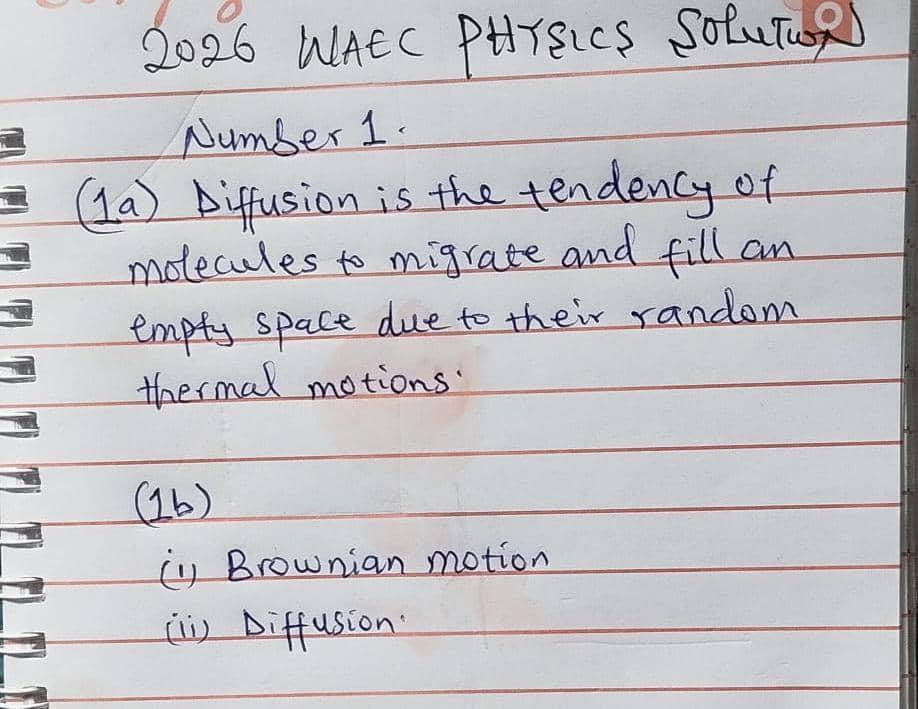
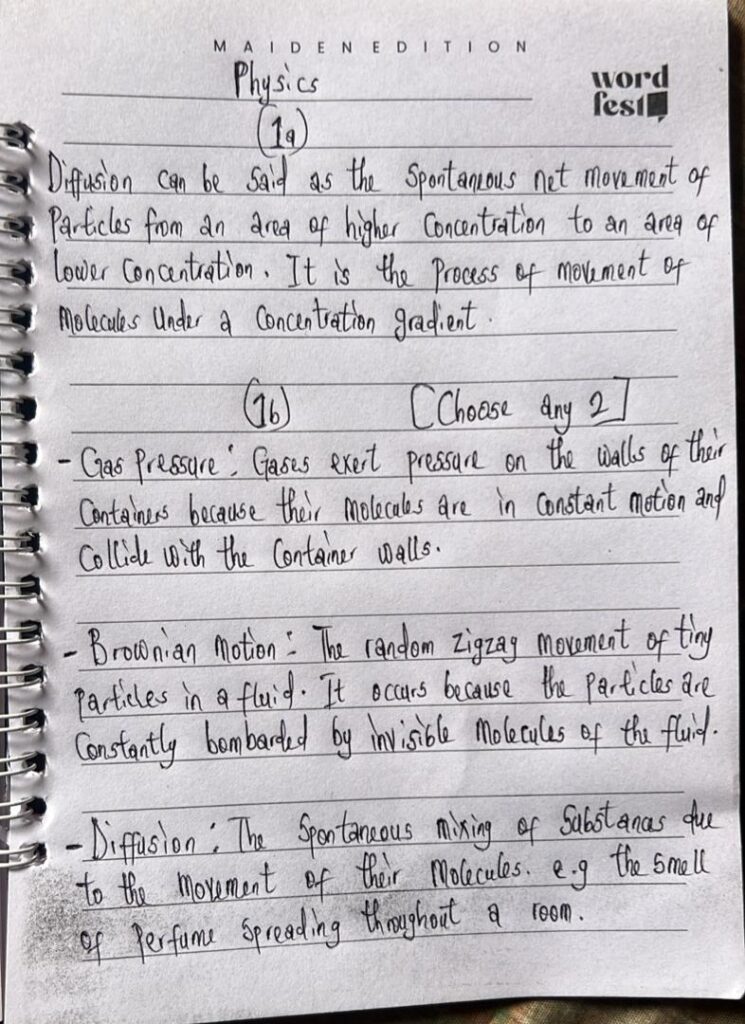
1a)
Diffusion is the process by which particles of a substance move from a region of higher concentration to a region of lower concentration until they are evenly distributed, due to their constant random motion.
1(b)
PICK ANY TWO
(I) Diffusion – e.g. the spreading of perfume smell in a room.
(ii) Brownian motion – irregular zig-zag movement of tiny particles suspended in a fluid.
(iii) Osmosis – movement of solvent molecules through a semi-permeable membrane.
(iv) Expansion of gases when heated – showing that particles are in constant motion and move farther apart.
========•••===========
NUMBER TWO
(2a)
(i) Majority carrier:
Holes
(ii) Minority carrier:
Electrons
(b)
CHOOSE ONLY ONE
(I) It requires no heater filament, so no heating is needed before operation.
(ii) It consumes less power.
(iii) It is smaller and more compact in size.
(iv) It has a longer lifespan and is more reliable.
========•••===========
Number 6
(6a)
A hard magnetic material is a material that is difficult to magnetize but retains its magnetism for a long time after being magnetized.
(6b)
Brownian motion.
====================
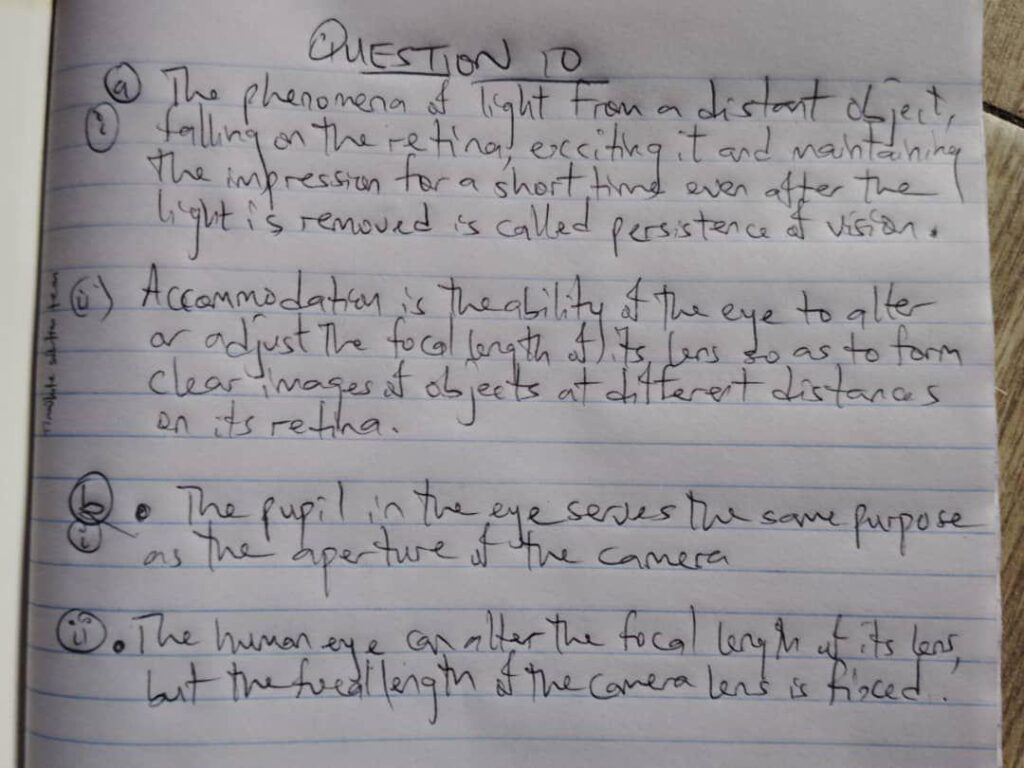
Number 10
(10a)
(i) Persistence of vision is the ability of the human eye to retain an image for a short time after the object has been removed from sight.
(ii) Accommodation is the ability of the eye lens to change its shape or focal length so that clear images of objects at different distances can be formed on the retina.
(10b)
(i) Both the human eye and the camera use a lens to form an image.
(ii) In the human eye, images are formed on the retina, while in a camera, images are formed on a film or light-sensitive sensor.
WAEC PHYSICS OBJ
01-10: DBDDCBDDCC
11-20: BBDACDCDDB
21-30: DBABCDBCCD
31-40: ADBDADDDBB
41-50: ACCCCAACBA
COMPLETED

2026 WAEC RECOMMENDED TEXTBOOKS FOR CIVIC EDUCATION
2026 WAEC RECOMMENDED TEXTBOOKS FOR MATHEMATICS
WAEC RECOMMENDED TEXTBOOKS FOR PHYSICS 2026
About Author
